Mathematicians and Physicist sometimes confront problems having two statements that are both true but in general,both cannot be true at the same time.These self-contradicting statements forms a paradox.I first read about them in Douglas Hofstadter’s Gödel, Escher, Bach: an Eternal Golden Braidand and since then I got more interested in these types of problems.Lets have a look at some of the most enthralling mathematical paradoxes!
Zeno’s Paradox
Zeno of Elea proposed four paradoxes in an effort to challenge the accepted notions of space and time.I will be writting about the first of his four famous paradoxes that attacks the notion held by many philosophers of his day that space was infinitely divisible.
Here’s the paradox: If Achillies and tortoise had a race and the tortoise was given a head start say a 100 meters and if we suppose that each racer starts running at some constant speed (one very fast and one very slow), then after some finite time, Achilles will have run 100 meters, bringing him to the tortoise’s starting point. During this time, the tortoise has run a much shorter distance, say, 10 meters. It will then take Achilles some further time to run that distance, by which time the tortoise will have advanced farther; and then more time still to reach this third point, while the tortoise moves ahead. Thus, whenever Achilles reaches somewhere the tortoise has been, he still has farther to go. Therefore, because there are an infinite number of points Achilles must reach where the tortoise has already been, he can never overtake the tortoise.
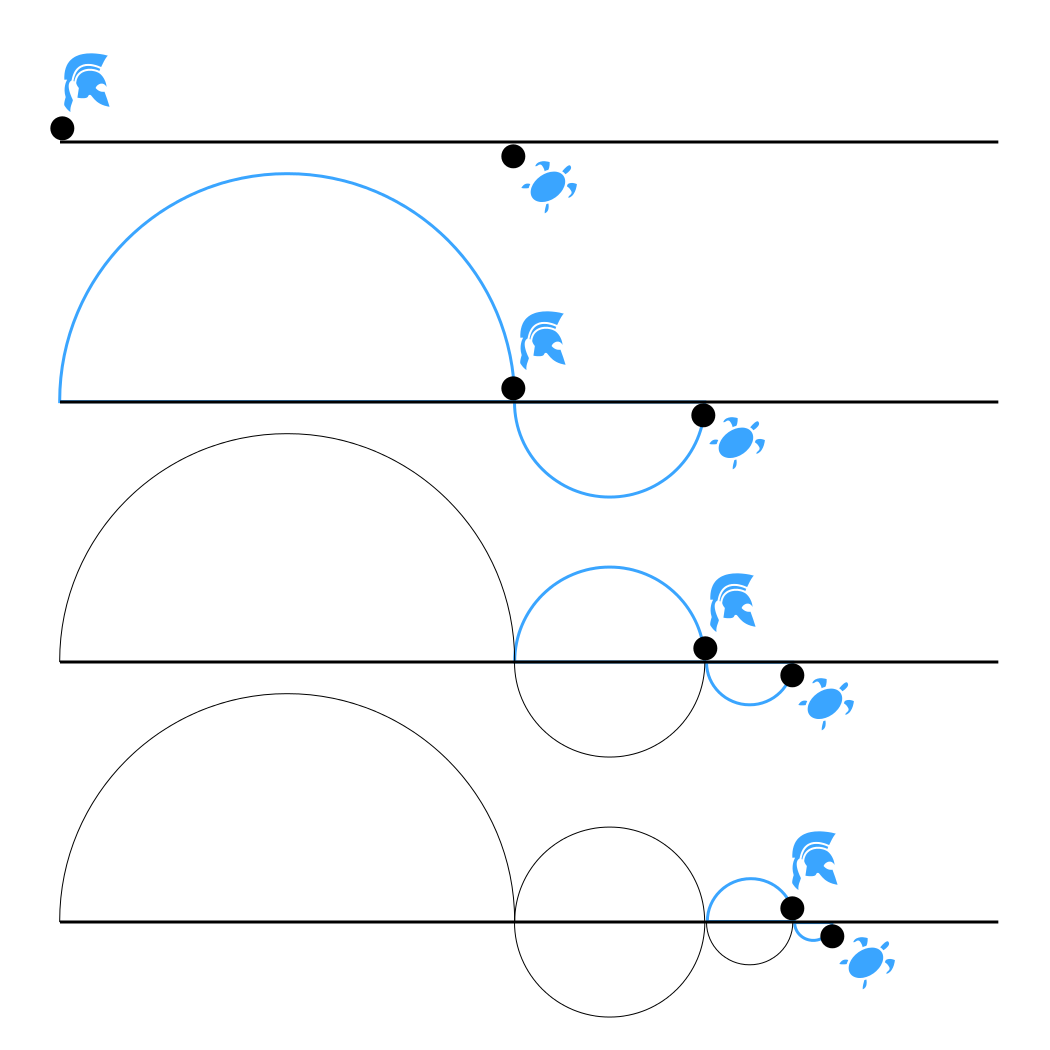
However,whatever the paradox might be in a real case scenario Achillies would easily over take the tortoise but why does the above statement also seems about just right?
As a matter of fact any person running from point A to another point B goes through infinitely many intervals so how is he able to reach point B?
Explanation
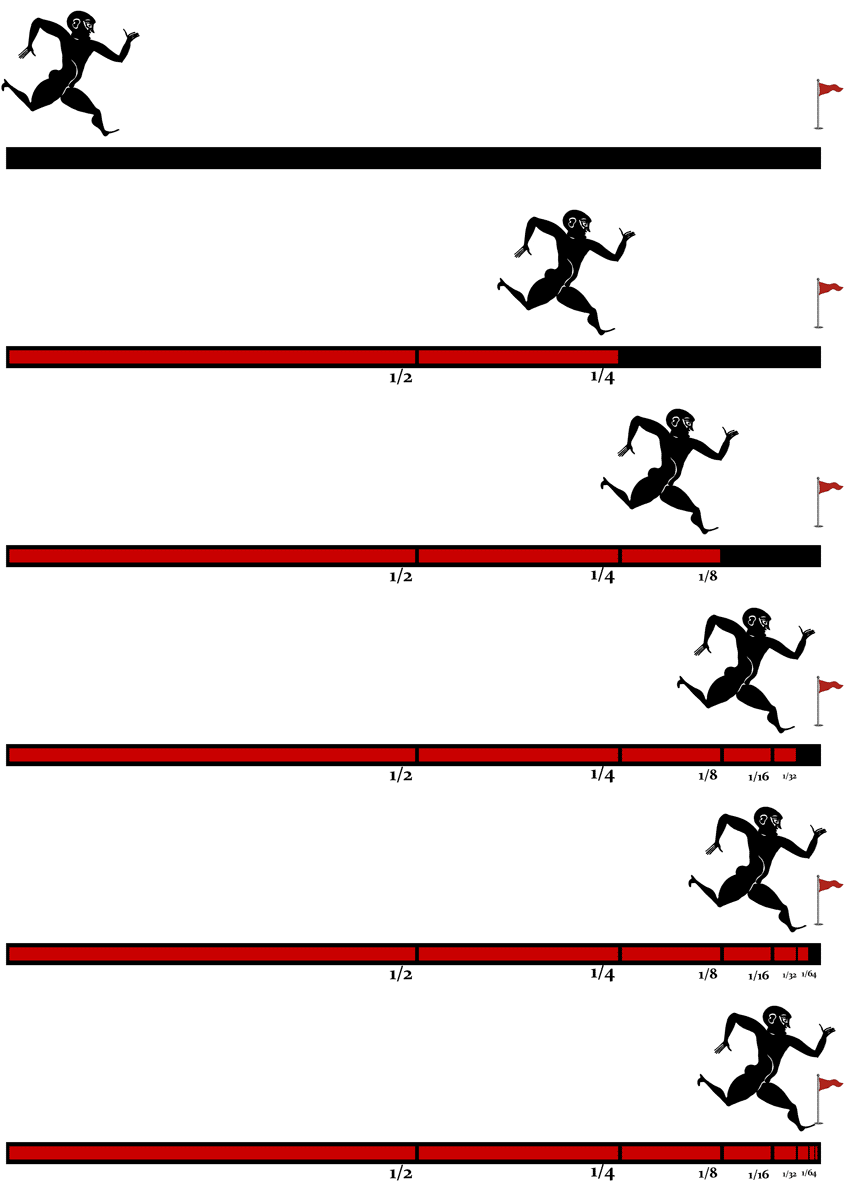
The answer to this is something to do with our conception of infinity.There are divergent series and convergent series. The most obvious divergent series is 1 + 2 + 3 + 4 … There’s no answer to that equation. Or, more precisely, the answer is “infinity.” If Achilles had to cover these sorts of distances over the course of the race—in other words, if the tortoise were making progressively larger gaps rather than smaller ones—Achilles would never catch the tortoise.
Now consider the series 1/2 + 1/4 + 1/8 + 1/16 … Although the numbers go on forever, the series converges, and the solution is 1. As long as Achilles is making the gaps smaller at a sufficiently fast rate, so that their distances look more or less like this equation, he will complete the series in a measurable amount of time and catch the tortoise.
Banach-Tarski Paradox
In 1924 STEFAN BANACH and ALFRED TARSKI two polish mathematicians stunned the mathematical community by presenting a mathematical sound proof of the following assertion :
It is theoritically possible to cut a solid ball into 9 pieces and by reassembling them,without ever stretching or wrapping the pieces, form TWO solid balls,each exactly the same size and shape as the original.
This statement is a proven mathematical fact that is beyond our understanding of how area and volume should behave for us the volume of a finite quantity should not double after rearranging its pieces !
Why can’t this be done in real life, say, with a block of gold?
What mathematicians have come to realize is that “area” is not a well-defined concept:not every shape in a plane can be assigned an area(nor can every solid in three-dimensional space be assigned a volume).There exist certain non-measurable sets about which speaking of there area is meaningless.The nine pieces used in the Banach-Tarski paradox turn out to be such non-measurable sets and so speaking of their volume is invalid.(They are extremely jagged shapes,FRACTAL in nature and impossible to physically cut out.)
Our simple intuitive understanding of area,works well in all practical applications.The material presented in a typical high-school and college cirriculum, for example,is sound.However,the Banach-Tarakshi paradox points out that extreme care must be taken when exploring the theoritical subteleties of area and volume in greater detail.
Try and figure out the Maths behind it with this paper written by Tom Weston
The Lawyer Paradox

This paradox is traditionally ascribed to the Greek philosopher Protagoras.
A law instructor accepts a penniless student under his wing for tution under the agreement that the student pay the tutor his fees if and only if he wins his first case in court.However, after qualifying as a lawyer, the student takes up a different career and never undertakes a first case.
The tutor later sues him for his fees.The student cleverly decides to represent his own case.This way,he reasons he need never pay the tutor his fees.If he wins the case,the ruling shall be that he need not pay,whereas if he loses the case, he would be exempted from paying as per his previous agreement with the tutor.Suprisingly,the tutor reasons too that he cannot lose.If the student wins this case,then he must pay the fees according to their previous agreement,whereas if the student loses,the ruling shall be that he must pay!

Bertrand’s paradox
French mathematician Joseph Louis Francois posed the following challenge:
Imagine an equilateral TRIANGLE drawn inside a CIRCLE.Find the probability that a chord chosen at random is longer than the side length of the triangle.
1.Once a chord is drawn we can always rotate the picture of the circle so that one end of the selected chord is placed at the top of the circle.It is clear then that the length of the chord will be greater than the side-length of the triangle if the other end-point lies in the middle third perimeter of the circle.The chances of this happening are 1/3,providing the answer to the problem.
2.Rotating the picture of the circle and the selected chord we can also assume that the chord chosen is horizontal.If the chord crosses the solid line shown then it will be longer than the side-length of the triangle.One observes that this solid line is half the length of the diameter .Thus the chances of a chord being longer than the side-length of the triangle are 1/2.
Suprisingly,both lines of reasoning are mathematically correct.Therein lies the PARADOX:the answer cannot simultaneously be 1/3 and 1/2.
If you enjoyed this post, I’d be grateful if you’d help it spread by emailing it to a friend, or sharing it on Twitter or Facebook. Thank you!