In my last blog I talked about this Greek mathematician Eratosthenes and how he worked the famous “Sieve of Eratosthenes” which was the first efficient way to determine which numbers are primes.The sieve is still used in modern number theory.But what still amazes mathematicians is how he was able to calculate the size of the Earth without leaving Egypt which was remakably accurate!
How did he go about it?
Eratosthenes was born in Cyrene,Libya,near the Mediterranean coast and lived a lot of his life in Egypt.He found out that on a certain day in Aswan(to the south of Egypt) at noon the sun was directly overhead a well thus whenever someone looked into it no shadow was cast.
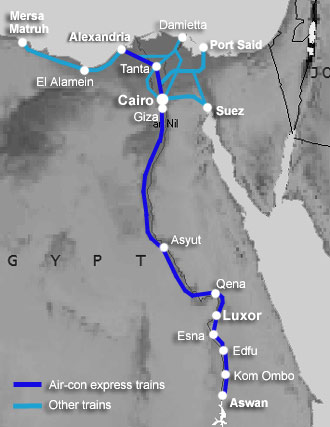
He then went to north of Aswan in the Mediterranean coastal city of Alexandria.Here the objects did cast shadows,the sun was never vertically overhead an object on any day.He possibly knew the Earth was round(which the Greeks knew anyway) and what he observed at the two places was due to the Earth’s curvature.Now with only this information in hand he decided to find the circumference of the Earth.
The challenge faced by him was not an easy one imagine something like this you have been given the leftover crust of a pizza and told to calculate its size.
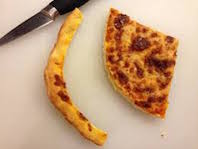
Let’s find out how he did it.
ThE CaLculaTioNs:
He used the simple rule we learned from Euclid that if you have a straight line that intersects two parallel lines,then the alternate angles are the same.
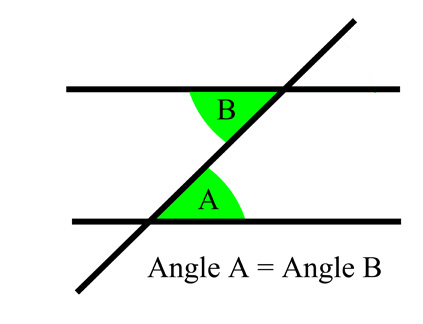
Yes,its true that the sun rays are not exactly parallel but because the sun is so much larger than the Earth,they were parallel enough for Eratosthenes.To get a rough idea have a look at my calculations:
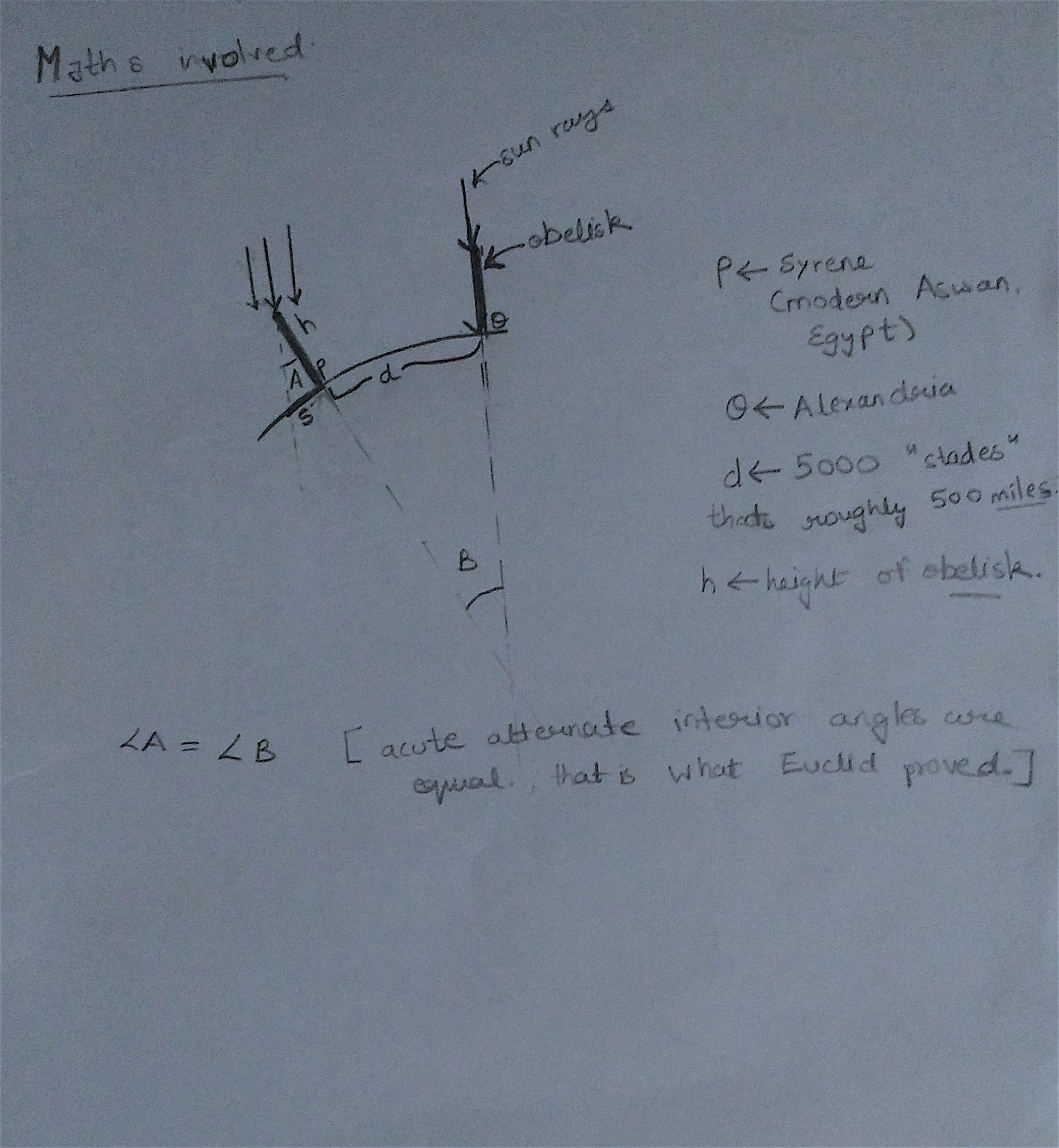
Obelisk mentioned above is a four-sided, narrow tapering monument which ends in a pyramid-like shape or pyramidion at the top.
Here ‘d’ is the distance between Alexandria and Aswan there are many theories as to how he got the distance one of which is that the distance was corroborated by inquiring about the time that it took to travel from Aswan to Alexandria by camel.
Values that we know
- ‘h’ height of the obelisk
- ’s’ length of the shadow that it casts in Alexandria
- ‘d’ distance between the two places
So all we need to do is to calculate the angle ‘A’ formed by the end of the shadow to the top of obelisk. This angle will be the same as the angle ‘B’.Once we know angle ‘B’ we can divide 360 by that angle and multiply the ratio by the distance from the well to the obelisk (i. e., Syrine to Alexandri) and we’ll have the circumference of the earth.
We don’t have Eratosthenes’ original paper (or rather, his papyrus) so we don’t know the exact numbers he had. But we do know if he had used a 20.7264 meter obelisk it would have thrown a shadow that was 2.616 meters long.
Using Trigonometry we know:
tan(∠ A) = opposite / adjacent = s / h; This means if the shadow is 2.616 meters and the obelisk is 20.7264 meter, the tangent of the angle ∠ ADE = 2.616/20.7264 = 0.1262.
If you look up the angle for that tangent - that is the arctangent of 0.1265 - you find the angle is 7.2 degree(approx.)
But since ∠ A and ∠ B are alternate angles from of the parallel sun’s rays. So we know that,
∠ A = 7.2 degrees = ∠ B
Now degrees are not absolute numbers but are relative values of how much of the circle the angle spans. For instance an angle of 36 degrees spans 100 × 36/360 = 10 % of the circle.
So from Eratosthenes’ calculation we know that 7.2 degrees spans the arc of the earth’s circumference that runs from Aswan to Alexandria. So the percentage of a circle between the two cities is:
100 × 7.2 / 360 = 2 %
So the distance from Aswan to Alexandria is 2%(1/50th) of the total circumference of the earth.
=> Circumference of the Earth = 50 × 500 miles = 25,000 miles thats 40233.6 km.
According to the most recent value from NASA, the circumference of the Earth is 40,075 km.That’s only a percent off!
Fun Fact:
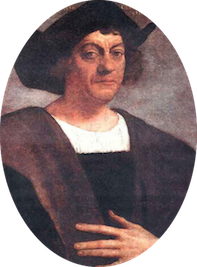 When Christopher Columbus went to explore the world he also calculated the size of the earth. He determined the earth had a circumference of about 15,000 miles - off by almost 40 %! Christopher was better at sailing than he was at math :)